Showing posts with label Culture and Traditions. Show all posts

Thursday, September 24, 2009

Narakng, The Salako Version Of The Festival Of Light, Sort Of: Part 1


Narakng is another peculiar ritual tradition of the Salako community. If this traditional culture is not properly preserved, it will soon see the verge of extinction due to the fierce onslaught of contemporary "modern" fast ever changing way of life. The verb Narakng is derived from the root word tarakng, which loosely means "bright or light or free from darkness". As in many cultures, darkness symbolizes grief, despair and misfortune. So, the act of Narakng is to beseech the Higher Being for the gift of light, which symbolizes well being and prosperity and all that is positive and beneficial for humankind. The Salako term for humankind is taino. To perform a Narakng ritual is therefore an act of asking the Higher Being/God for the bestowal good health, peace, well being and plentiful harvest. The Salako equivalent for the Higher Being/God is Jubata. Jubata is also commonly referred to as Jubata Panampa' or God the Creator.

Narakng is rarely an annual affair due to it's exhaustive and meticulous nature to perform. Normally this very significant customary ritual is held at an interval of three to five years. However though, there were rare instances when it is performed at alternate year especially when the state of being of the (Salako) community is in acute hardship due to extreme misfortune such as severe drought or flood or a pandemic of illness.

A Narakng usually involves at least a few villages or kampokng, so the expenses for it to be held is naturally hefty. This though is not a hindrance because prior to one, there would be a bararis. A bararis is an act of voluntary contribution in the form of cash and kind. To this, every household or family and individuals would chip in without much fuss. Bararis is sometime referred to as nyangker. In the event that a Narakng would involve the whole Salako community like the one held in 1968, every kampokng is then required to perform their own rarisatn (derived from the root word raris). This though is extremely rare due to the huge logistic needed to cover the whole geography which may take days or even weeks.


The 'Tukang Baiyatn Narakng", Mr Lembi Ak Benet readying himself for the ritual.


Preparing the offertory prior to opening prayer of the Narakng.


The "Tukang Baiyatn Narakng" listening attentively to the opening prayer


The Binua/Tuha Binua, Mr Milos Ak Nimbun reciting the opening/offertory. The Salako call this the "Ngantek/Nyangahatn Pamadah"


The Narakng procession about to begin, starting to walk out of the "bantang" or longhouse


The Narakng procession going down from the "pante bantang" (long house veranda) to travel to the assigned route and locations.


A "Ngantek Pamadah" at the "Batu Pangada", a monument which mark the centennial existence of Kampokng Poe (Kampung Pueh)


The Baiyatn Narakng walking but with a some kind of a dance for this ritual.


Earthen jars at the "Pabuisatn" where "ngantek pamadah" is also performed.


The "Ngantek Pamadah" at the "Pabuisatn".


The Narakng procession moving out of the village towards another location.


The Narakng procession getting momentum when more people joined in as it passes by their houses.


The "Panyangahatn" doing a "Ngantek Pamadah" at the "Batu Pangada". This "Batu Pangada" is of note because on this monument is marked the date when Gawai Dayak is made the official state celebration. The writer (with vest) doing an audio recording of the prayer mantra.


A journey to the "kompokng tuha". A kompokng tuha is the oldest fruit orchard of a particular village where the  first settlers planted their fruit tress of various species notably the durian, langsat and ellipe nuts or the engkabang trees.

Stay tune for up coming series of Narakng.

Note:
The writer sincerely acknowledged and hold high the contributions of every Salako brethren from Kampokng Poe (Kampung Pueh) who have unceasingly tried hard to keep alive this rare and unique Narakng culture and tradition.

Friday, August 7, 2009

Traditional Medical Specialists of the Salako Community

Like any other cultures the world over, the minute Salako community of Sarawak, Malaysia, once upon a time has their own “medical specialists”. These “medical fraternity” were usually from the male gender but on rare instances, there do exist their female counterparts which are very far and between. They were supposed and believed to have the capabilities of curing all sorts of aliments ranging from simple flu to sickness of being possessed by evil spirits. The intriguing things about their diagnosis and prognosis about one’s ailment were that on almost all instances, these sickness were caused by bad spirits. The common Salako term used to describe these illnesses was “takana jukut” where “takana” means ”affected by/inflicted by/caused by“ and “jukut” may means “mediums/things/objects/subjects”, usually of the unseen or unknown. Imagine if now were then, when the H1N1 pandemic is causing havoc the world over, these “medical specialists” would have been very busy performing their rituals from village to village, having very little time to rest and be with their families.

Now though however, specifically since about a quarter of a century ago, almost all of these “medical specialists” have gone out of job. And these professions, usually handed down from heir to heir, have forced those “qualified” to switch to other job opportunities to make ends meet. Like their modern counterparts now, these “medical specialists” were referred to by many names, according to their “skills and capabilities”. Following are the titles or terms they were referred to.


Mr Kidi Ak Baloto, performing a Baiyatn demonstration show during his cousin's wedding night sometime ago.


Pa’ Tenteng – The Pa’ Tenteng or Tukang Tenteng were usually engaged to cure light illnesses such as simple flu, stomach ailments or headaches. Since the engagement were relatively simple, not much preparation were really needed. Neither were there too many minders or onlookers when the ritual is performed. Usually, only close relatives and friends were at hand to witness. The accompanying musical tunes during the ritual were that from the sound of chiming of china plates of different sizes to create the different pitch sound. Thus the “Batenteng”, derived from the “teng, teng, teng” sound of the china plates when struck using certain wooden stick. We can thus also, if we will, equate the Batenteng performed by the Pa’ Tenteng to the modern “general practitioner” where only ordinary medical appointments were made.


Another frame of Mr Kidi Ak Baloto doing the Baiyatn demo.


Pa’ Dukun – This title is conventionally believed to be one step ahead of the Pa’ Tenteng. Pa’ Dukun can also be refered to “Tukang Dukun” or simply Dukun. The occasion when a Pa’ Dukun is engaged to performed his “medical appointment” is called “Badukun”. Prior to performing a “Badukun”, the Pa’ Dukun must first be invited or approached to get his agreement or consent. This was usually done a couple of days before the occasion. The Salako called this “Ngaap” or “Ampus Ngaap”. It was not unusual for “Pa’ Dukuns” from a different village were engaged to perform the ritual though there might be available persons of the same caliber within the same village. The reasons though were unclear but it might be the “Familiarity breeds contempt” kind of phenomenon. In Malay, they called this “Bomoh Kampung Tidak Mujarab”. So much so! The Badukun involved quite an elaborate preparation which may take a whole day to complete. The Pa’ Dukun has an assistant, called the Panade’, akin to a co-pilot or a medical assistant of that sort. The duration of a Badukun is usually for one night, rarely two.


Mr Kidi Ak Baloto with yet his step.


Tukang Baiyatn – The “Tukang Baiyatn” can be referred to as a “Baiyatn” or “Dukun Baiyatn”. His status or capabilities is believed to be above that of the “Pa’ Dukun” as earlier described. Anything an ordinary “Pa’ Dukun” can’t handle might be best suited for a “Tukang Baiyatn”. Like the Badukun, the Baiyatn needed a much more elaborate preparation still. First, there must be a “Ngaap” (as described above), then followed by a very thorough and meticulous preparations, done only mostly by people “in the know”, usually the elders of the village. There need to be the “batakng taman”, a special platform made from a banana trunk where the Tukang Baiyatn would perform most of his prayers and mantra during the whole engagement. Like in the Badukun, a Tukang Baiyatn is assisted by a Panade’. Then there must be the “Anak Dalam”, three, five or seven of them, depending on the requirements as requested by the Tukang Baiyatn. The Anak Dalam are usually unmarried ladies, preferably in the teens. These Anak Dalam will on a certain section of the ritual assist the Tukang Baiyatn and the Panade’ to “Ngayuh Ajukng”, a symbolic act of “rowing a boat” when the Tukang Baiyatn would be “searching for the sickness of the patient and bringing back the cure”. An “Ajukng” is a “toy junk” or a small model sailing boat. Depending on the severity of the sickness of the patient, the Baiyatn is performed between one to three nights. Just as in the Badukun, the whole village folks were required (invited) to witness the ceremony from beginning to end. This act is called the “Ngarunukng”, meaning to attend, to be present or to witness. Gongs and “Tuma’” and other percussions are used as background music as in the Badukun. Tuma’ is a certain hand held drum made of wood and animal hide.


He could be a real Tukang Baiyatn if it were thirty or forty years ago.


Tukang Lenggang – Sometimes referred to as Pa’ Lenggang or simply Lenggang. Of all the four, the Lenggang is the most potent of the traditional healers. Any illnesses stubborn enough that could not be handled by a Pa’ Tenteng, Pa’ Dukun or Tukang Baiyatn are normally referred to a Lenggang. Since a Balenggang (a ceremony where a Lenggang performed his ritual) is the most “complex and sophisticated” of the four, there need to be a very serious deliberation amongst the concerned village folks prior to calling one. The expenditure could be relatively very huge as compared to others but normally, the burden of preparation would be shared by every family in the village by way of donations. These donations will be in the form of labour, rice, sugar, chickens and all there need to be to sustain the whole period of the ritual. The same applies to the Batenteng, Badukun and the Baiyatn. Call that Love and Mercy in motions!


Almost similar to a Baiyatn, a Balenggang need to have a Panade’, the Anak Dalam, the Batakng Taman, the Ajukng and much more. Depending on the severity of the sickness of the patient, there sometime is a need to slaughter a dog, preferably a black one, of which blood is believed to have the power to neutralize many forms of curses. The Balenggang is performed between one to three nights, all depending to the “diagnosis and prognosis” of the Pa’ Lenggang.

After performing any of the four rituals (ie the Batenteng, Badukun, Baiyatn and the Balenggang) the affected family need to have a Balala’ or Basansam between three to seven consecutive days, depending on the advice of the “medicine man”. A Balala’ or a Basansam is an actual fact a modern day quarantine, giving the treated patient enough rest and probably to “contain the spread of disease”.


Note 1
: The above entry is based on the experience of the writer during his younger days almost three decades ago. Some information may slightly differ according to places. However though, the writer made a serious effort to verify the facts by referring to elders whom he considers are able to give the correct information.

Note 2: The Salako community by tradition did not have the Baiyatn and the Balenggang as a way to cure sickness and diseases. This culture was “borrowed” and adapted from the Rara (Bakati’) community. In fact, all the Baiyatn and the Balenggang that the writer had witnessed first hand were all done by the Rara mediums themselves.

Note 3: By tradition and culture, the Salako and Rara communities were never at loggerheads with each other, thus both communities can easily assimilate with each other, while keeping their dialect/language distinctively their own.

Note 4: All factual corrections and comments are most welcomed so that this entry could be revised and updated.

Thursday, March 5, 2009

Ngoncong: A Fast Dying Cultural Heritage Of The Salako Ethnic Community

Like almost all ethnic cultural traditions, Ngoncong, the cultural heritage of the Salako ethnic community, is fast dying, immersed almost suddenly by the advent of modern forms of entertainment. Back in the 1980's and before, Ngoncong was among the most preferred cultural form of entertainments held during gawe (joyous festivals) of all sorts.

Among those are the Ngarantika, festival marking the start of padi harvesting season; the Ngabayatn, marking the end of padi harvest; the Basunat or male circumcision; the Batenek or the piercing of female ears. The gawe Basunat and Batenek marks the coming of age of Salako boys and girls into "adulthood". Other gawe (joyous festivals) where Ngoncong is considered to be a must is the Nangket or Panganten (marriage), thanksgivings moving in to a new house, or any other merry occasions such as celebrating the plentiful harvest of any other agricultural toils. Others include the Nampukng Tawar (akin to child baptism), Mayar Moot or Mayar Niat such as when a dear family member recovers fully from a serious sickness.

How many nights the Ngoncong is hosted by a family depends on how grand the celebration is, which also reflects on the status of the particular family in the kampokng (village) or area. The most common duration is for a night only but two nights is not uncommon. Three nights is quite rare and seven nights in a row is rarer still but there are stories of such.

The number of dara koncong (female dance performers) varies from one, two, three or seven. This also reflects on how joyous or grand the occasion is supposed to be and this also usually denotes the host's status in the society.

The important actors in a Ngoncong is the panyangahatn who recites the prayer before the do; the panade' (usually senior male) who recites the hymns or mantra during the entire performance; the tuha koncong (lead dancer, usually senior female trainer); the dara koncong (consisting of one, two, three or seven female dancer(s) - usually unmarried in their teens); the pangesek bilola (violin player); the tukang panoko' agukng (the gong player) and the tukang ganakng or panuma' (the person who plays a type of drum or membranophone).

Nyondok is a term used to describe the 'proper' witnessing of a Ngoncong session. These panyondok are seated on stools, chairs or benches usually placed encircling the Ngoncong area. Each session of a Ngoncong usually ends with the batanda' when those panyondok (congregants proper) may dance with the koncongs lasting up to about half an hour or so. Ordinary onlookers who do not nyondok (congregate proper) are not allowed to participate in the batanda'. At the end of the batanda', each panyondok is obliged to contribute a little monetary token as a sign of gratitude and feelings of joy. The session may be repeated till dawn as long as there are "enough" panyondok.

The kajantera marks the final episode of a Ngoncong. It is also usually the peak where those who do not have the chance to nyondok during the earlier night session(s) would not miss to participate. On most occasions, the kajantera is held on the morning after the gawe has ended.

Related article in Salako can be found here.

The paantaratn koncong or the paaparatn where the offerings are placed before a Ngoncong begins.

A female tukang panyangahatn recites the prayer to the spirits invoking their blessings so that the Ngoncong may be an occasion of joy to both host and guests.

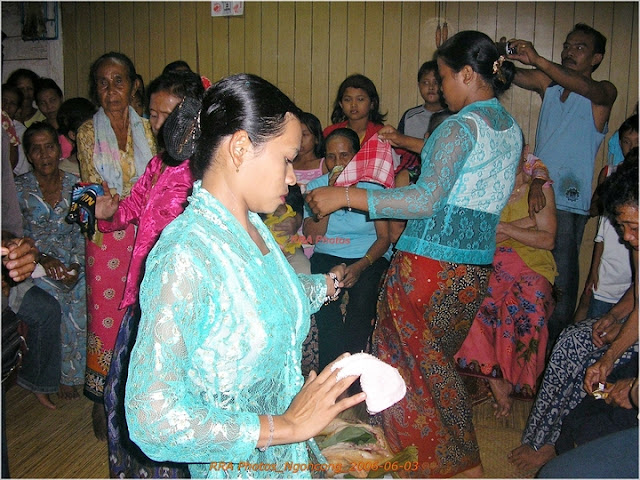
Together with the host (nearest), the koncongs put their hands on the paantaratn which signify their willingness to perform the Ngoncong.

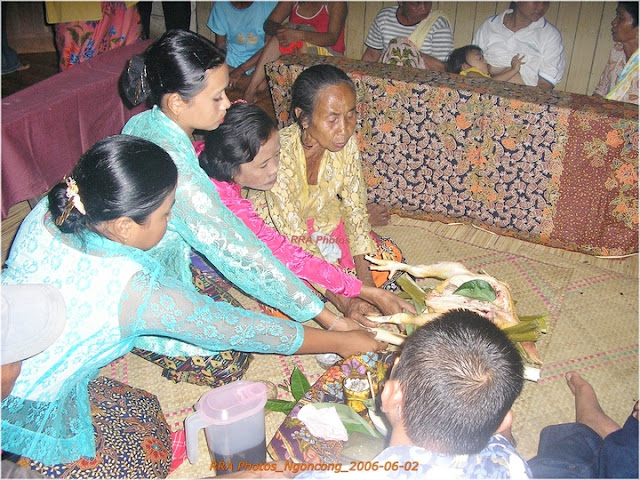
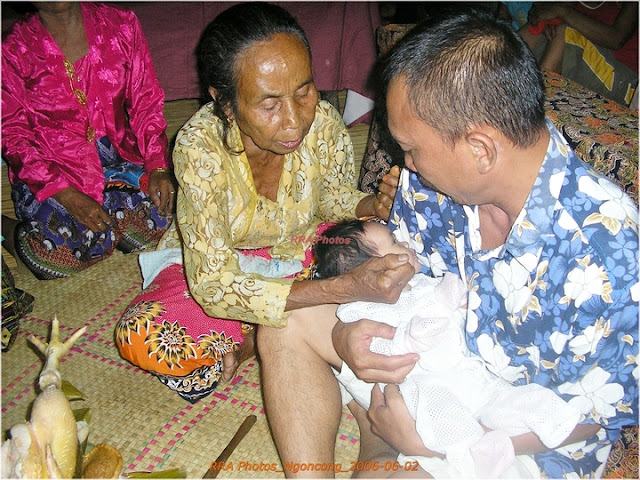
The basaru' sumangat when the tukang panyangahatn invokes the good spirits to protect this little child. (This Ngoncong is performed on an occasion of a Nampukng Tawar)

The panade' (with cap) starts with the hymns/mantra signaling that the Ngoncong is to begin.

The bakase baangir, (bakase angir) a blessing rituals first begins for the host before on anyone else.

The panyondoks also get their blessings, the bakase baangir.

The bacaek minyak, or anointing with oil on the forehead is also part of the blessing ritual being performed on the host (the baby). The oil must be from a home brewed coconut oil.

The panade' and the koncong performing the blessing and anointing ritual on the panyondoks.

Again the bakase baangir for the panyondoks. This ritual symbolizes the acts of cleansing of hearts and souls upon them.

This act symbolizes the acts of acceptance, willingness and unity between the koncongs and the host.

The ngoncong begins. Those seated are the panyondoks.

The graceful dance of a koncong.

A Ngoncong in full progress.

To listen to a Ngoncong audio, please click here.


Acknowledgment:
Thanks to Biado of Nangkat Salako and Kelab Kebudayaan Kpg Serayan, Lundu for the Ngoncong audio.

Thursday, December 18, 2008

Nangkat - Real or Virtual: A Place Where Visitors Meet And Discuss

Long ago, like most Dayak tribes, the Salako people lived in long houses or bantang. It is customary that visitors from far away who need to put up their nights in a long house would be hosted in a sami'. A sami' is the non partition section (from end to end) of the bantang, more like a common/living room shared together by the whole families living under one roof. Each family has their own separate partition which is called biik. A biik also usually refers to a family, thus biik mister so and so, would simply means the family of the person referred to.

Pintu (door) is the term used when referring to the number of families living in a bantang. This also will tell us how long the bantang is. A bantang ampat puluh pintu, would, for example, simply means a forty door long house with forty families living in each separate biik. The longest ever known bantang to have been built by the Salako people was a ninety nine door long house in the early 1800's under the wife-husband leadership of Ne' Ketep and Ne' Ngante. It was built in Kampokng Sidamak near the foot of Gunung Gading.

In the sami' there can be as many nangkats as there are the number of families living in the bantang. A nangkat is a cubicle where (especially adult male) tamoe (guests or visitors) from far away would spent their night(s) if the need arise. Here is a place where a lot of chats or discussion between hosts and guests would take place until as long as the guests and the hosts are not sleepy. If there aren't any visitors, the nangkat would be the most probable place where the bantang folks would chit chat at any 'free time' regardless if the sun is above head or not.

Today, Kampung Pueh (Kampokng Poe as the Salako calls it) is the only Salako village which still has a real bantang in every sense of it. Kampokng Poe is located towards the western end of Sarawak. It comes under the jurisdiction of Sematan Sub-District, a town popular with it's beaches and sea products.

Now however, quite a number young educated Salako are trying to emulate the bantang, sami' and nangkat concept and philosophy into the virtual world. Thus a young guy who nicknamed himself Biado (knife sheath) has setup a virtual Nangkat so that internet savvy Salakos from anywhere in the world could gather and share whatever ideas they may have amongst themselves. He aptly named this networking site as Nangkat Salako. In fact, it is not only for the Salako people but for all Dayaks and non Dayaks as long as they share the same philosophy of freely sharing ideas. Anybody especially any Salako who wishes to become a Nangkat Salako member must register to be one. Readers are kindly invited to click here to visit Nangkat Salako.

The sami'. On the left side are cubicles without doors called nangkat. Here on the sami', people are enjoying food served during a marriage celebration of a prominent personality's son. Notice how mature bamboos are used as dish containers.

Never underestimate an elderly dancer. Seen here is a peoples' representative (white shirt, with glasses) trying his best to outdo this elderly man who happens to be his uncle. Behind we can see people sitting on the nangkat.

See how graceful this elderly is dancing to the beat of the tuma'. Onlookers are clearly enjoying the show. Where else to celebrate if not in the sami' of the bantang?

How useful a nangkat can be. One can do anything on it, even playing a gulentang (musical instrument made of special wood) as the two elderly showed us.


"Long ago there were no such thing as beer", explains this old man. "Now", he says, "beer can make one dance or play the tuma' (a small wooden percussion) much better". Of course he seems to be oblivious to sound beat of the tuma' played by the present highest Salako community leader, Pemanca London Anak Tasin.

Nangkat is really a general utility cubicle. Put anything on it when there are no visitors or tamoe. Food, drinks, fruits, musical instruments will come handy on a nangkat.

To the left is a bounded sleeping mat made of pandan (pandanus mats). When everything is cleared, one can just unbound the mat to sleep on with pillow and a blanket included. Life could not be more simpler than this.

Visitors or tamoe sitting on the nangkat. Notice more pandanus mats at the back ever ready to be unbound on the nangkat for just about anyone to sleep on.

This is an enlarged thumbnail of the virtual Nangkat Salako creator. He calls himself Biado (knife sheath). This young guy is a graduate of Universiti Utara Malaysia in 2002. He now works in a management company in Kuching.

What one would see on Nangkat Salako front page.

The header on Nangkat Salako reads "Tampat Salako Batamu" which means "A place where Salako people meets" - virtually that is.

Another most recent view of Nangkat Salako front page.


Friday, December 5, 2008

A night to remember: Majlis Makan Malam Dayak Borneo

It was very well worth attending. Why? Because that was the night when almost a thousand Dayaks from both Malaysia and Indonesia congregated at the Majlis Makan Malam Dayak Borneo (Borneo Dayaks Dinner Gathering) held at the Dewan Suarah, Kuching (4th December 2008). The occasion was organized by Sarawak Dayak National Union (SDNU) and it's affiliates to honor the visit of His Excellency The Governor of Kalimantan Tengah, Bapak Agustin Teras Narang, SH, and his entourage of about a hundred and fifty who came for a three day visit of Sarawak and Sabah. They came on a chartered plane. They were also accompanied by more than fifty fellow Dayaks from Kalimantan Barat who arrived by land. Never before was there a gathering of such a magnitude of Dayaks from both countries for such an occasion or any other for that matter.

No politics. To me, there were no politicians that night, just fellow brotherly Dayaks sitting under one roof to cordially enjoy food, friendly smiles, handshakes and cultural performances. There were a lot of movements while enjoying food when fellow Dayaks went to each others' tables to share their smiles, handshakes and brotherly sessions of short questions and answers.The occasion was most entertaining, even mesmerizing when cultural troupes from both sides gave their presentations. What was most wonderful (at least to my eyes and ears) was when the fellow Dayaks troupes from Kalimantan Barat and Kalimantan Tengah performed their acts, each distinctively portraying the various uniqueness of the region they come from.

Below are some pictures as seen from behind my camera for those who missed the occasion. Please click on pictures to see larger images.


The Miring. His Excellency, Bapak Agustin Teras Narang, holding the rooster, performing part of the miring, while the President of SDNU, Mr Mengga Mikui (white shirt) looks on.

His Excellency, Bapak Agustin Teras Narang (left) and the President of SDNU, Mr Mengga Mikui at the miring.

Guests waiting patiently while miring was performed by the VIPs.

The singing governor, His Excelency Bapak Agustin Teras Narang

Before airplane was ever invented, Dayaks already knew how to fly.This Flying Dayak from Kalimantan Tengah soars up in the air leaving his maidens waiting below.

A Dayak gymnast. He won a standing ovation that night.

Two one-legged Kalimantan Tengah Dayaks jumping around.

He closes his eyes before he flies.

Queen of The Peacock Throne. A beautiful Dayak lady from Kalimantan Barat showing off her beauty and elegance.

Exchange of memento between His Excellency Bapak Agustin Teras Nerang and the President of SDNU, Mr Mikui Mengga.

The beautiful triplets from Kalimantan Tengah.

These Dayak Warriors from Kalimantan Barat, having a meal with their ladies before the battle begins.

"This lady is mine for a ransom", says the male warrior dancer. Fret not, there was no head hunting or hostage taking that night. It was only a cultural show.

Playing the flute to appease the ladies.

They are not trying to chop off the head of each other or fighting over ladies or food. Just a warrior dance show.

These male Dayaks from Kalimantan Tengah with their unique headgears.

Our local Dayak beauties not to be outdone in their Dayak Bidayuh costumes.

Another three of our local Dayak beauties in their Dayak Iban costumes.

Flying one legged. There's no need to go to Malaysia by a chartered plane.

You shoot their picture, I shoot your picture. This wonderful lady and a gentleman from Kalimantan Tengah taking shots of the dancers.

The identical twin from Kalimantan Tengah attempting to take off to the air.

One for the album.The writer, (blue pants, front middle) with friends and dancers from Kalimantan Barat.

Posing with two old lost friends.

Dayaks from Sarawak, Kalimantan Tengah and Kalimantan Barat posing after the dinner ended.

For the benefit of those who are not able to attend the dinner, more images can be viewed from here.


And below are five versus of my pantun proclaimed on that memorable night.

Dari betang mencari paku,
Untuk dimasak dengan peria,
Selamat datang wahai rumpunku,
Semoga tuan rasa gembira.

Kalimantan nama diberi,
Borneo itu pulau yang sama,
Walaupun kita berlainan negeri,
Bersatupadu tonggak utama.

Dari Kal-Teng sampai ke Kal-Bar,
Tampil kemari dengan pesawat,
Kita Dayak terkenal tegar,
Bila bersatu bertambah kuat.

Singgah di pasar membeli anggur,
Untuk diperam membuat ragi,
Semoga tuan rasa terhibur,
Lain peluang datanglah lagi.

Adil Ka' Talino tekad dinyata,
Bacuramin Ka' Saruga pegangan kita,
Bila Dayak Basengat Ka' Jubata,
Semua impian menjadi nyata.